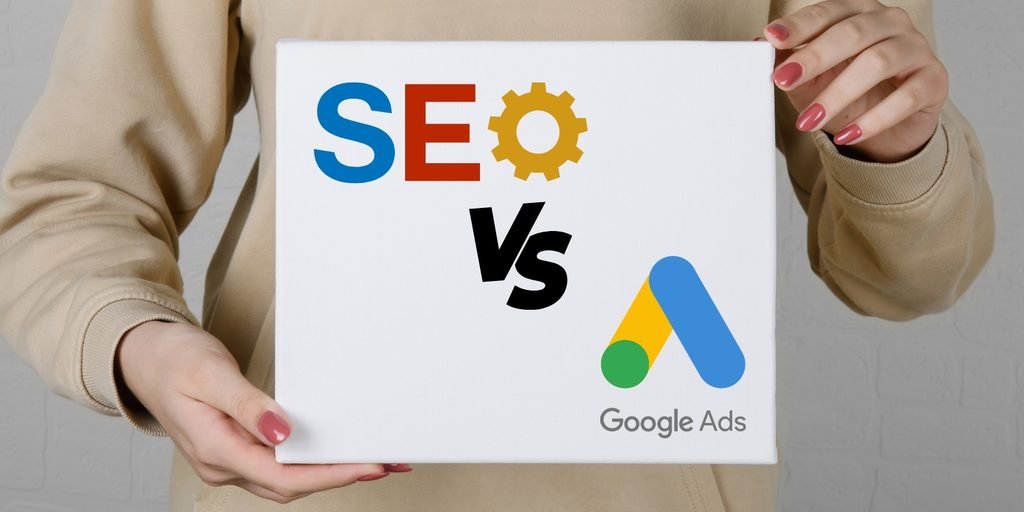
“Should I invest in SEO or Google Ads?” It’s one of the decisions that moves the most money in a small business’s digital marketing, and also one of the most frequently gotten wrong. Not because one option is better than the other, but because it’s almost always framed as an either-or choice when in reality they’re tools that solve different problems.
In this article we give you concrete criteria to decide: what each channel brings you, how long they take to deliver results, what they really cost and when each one makes sense.
The key difference in one sentence
Google Ads buys visibility. SEO builds it.
With Google Ads you pay to show up. Stop paying and you stop showing up. It’s renting.
With SEO you work to earn your position. Once you get it, it holds without any cost per click. It’s ownership.
Neither is inherently better. The right question isn’t which one is best, but which one solves the problem you have right now.
Head-to-head comparison
| SEO | Google Ads | |
|---|---|---|
| Time to results | 3-6 months (up to 12 in competitive industries) | Hours |
| Cost per click | €0 once you rank | Always paid |
| Effect when you stop | Traffic holds and declines slowly | Traffic disappears immediately |
| Control over the message | Limited | Full |
| Speed of testing | Slow | Immediate |
| Scalability | Limited by organic demand | Scale by increasing budget |
| User trust | High (organic result) | Lower (labeled as an ad) |
| Long-term cost | Decreasing per visit | Constant or rising |
When Google Ads is the right answer
You need revenue now
If your business needs sales this month, SEO isn’t the tool. An article published today won’t bring traffic for months. A well-built campaign can bring you your first lead this afternoon.
You just launched and have no domain authority
A new domain competes at a disadvantage for the first few months. Google Ads lets you be visible from day one while SEO matures in parallel.
You want to validate something before investing seriously
This is the most underrated use of Google Ads. Before investing six months of SEO in a content cluster, you can spend €300 on Ads and find out which keywords actually convert, which messages work and which landing page performs best. That data gives your later SEO strategy a head start instead of relying on assumptions.
You have seasonality or one-off campaigns
Black Friday, sales, a product launch, a local event. SEO can’t be switched on and off. Ads can.
Your target keywords are out of reach in the short term
If you compete in an industry where the top ten results are fifteen-year-old domains with thousands of links, breaking in organically is a multi-year project. Ads give you presence in the meantime.
You sell high-margin products with a short sales cycle
When each conversion is worth a lot, the cost per click is easily absorbed. In these cases Google Ads can be profitable from the very first week.
When SEO is the right answer
Your cost per click on Ads is unsustainable
In some industries CPCs have climbed to levels that make advertising hard to turn a profit on. When every click costs 4, 8 or 15 euros, SEO stops being a slow alternative and becomes the only sustainable path.
You think in years, not months
SEO is an investment that appreciates. A well-ranked article keeps bringing traffic two or three years after it was written, at no extra cost. The cumulative sum of those assets is what makes the organic channel’s cost per visit drop month after month while the cost of Ads stays the same.
Your audience researches before buying
If you sell services or products with a long decision process, your customers run lots of informational searches before they’re ready to buy. Those searches are extremely expensive, or simply impossible, to make profitable with Ads, but they’re natural territory for SEO and content.
You want to build brand and authority
Showing up organically in the top results conveys authority in a way an ad never can. Plus, ranking content builds your credibility, attracts links and strengthens your overall presence.
You run a local business
For businesses with a physical presence, local SEO delivers an exceptional return. Appearing in Google’s map pack for searches in your area generates a steady stream of calls and visits for far less investment than competing on Ads for those same searches.
You want visibility in AI search engines
This factor is new and increasingly relevant. Generative search systems cite quality content, not ads. If you want your brand to show up when someone asks an AI for recommendations in your industry, the path is content and authority, not advertising.
The real answer: combine them
Treating SEO and Google Ads as mutually exclusive is the most common mistake. The businesses that get the best results use both, but with distinct roles and taking advantage of the synergies between them.
Ads feed your SEO strategy with real data
Search Console tells you which keywords bring you traffic. Google Ads tells you which keywords convert, with data in days instead of months. That information is gold when deciding which content to invest your SEO effort in.
SEO gradually reduces your dependence on Ads
As you rank organically for the keywords you used to pay for, you can reallocate that budget to more competitive terms or other channels. The goal isn’t to eliminate Ads, but to stop relying on them exclusively.
Owning both spaces multiplies your visibility
Appearing in both the ad and the organic result at the same time increases the likelihood of a click and reinforces the perception of a solid brand.
Remarketing makes organic traffic pay off
Traffic from SEO doesn’t always convert on the first visit. With remarketing campaigns you can win those visitors back with minimal investment. It’s one of the highest-return combinations out there, especially in ecommerce.
Landing pages serve both channels
A well-built page performs on Ads (better Quality Score, lower CPC) and in organic search. The optimization work pays off twice.
How to split your budget based on your situation
These splits are guidelines, but they reflect what works in most of the cases we see:
New business with no traction (0-6 months): 70% Ads, 30% SEO. You need revenue while you build your organic foundation. SEO at this stage focuses on technical fundamentals and structure, not content volume.
Growing business (6-18 months): 50% Ads, 50% SEO. SEO starts paying off, but you still need Ads for volume and for the keywords you can’t reach yet.
Established business (18+ months): 30% Ads, 70% SEO. Organic sustains your baseline traffic and Ads are reserved for campaigns, seasonality, remarketing and highly competitive keywords.
Very tight budget (under €500/month): focus on just one. Splitting a small amount between two channels usually means neither reaches the minimum threshold to work. If you need sales now, put it all into Ads with a very niche focus. If you can wait, put it all into SEO, starting with technical and local.
The most expensive mistakes
Hiring SEO and expecting results in a month. It leads to frustration, premature cancellations and wasted investment right before it would have started paying off.
Relying exclusively on Ads for years. Every month you start from scratch. If a competitor raises bids or you change account managers, your revenue takes an immediate hit. You haven’t built any assets.
Doing SEO without a technical foundation. Writing content for a slow, poorly structured website with indexing problems is throwing money away. Before producing content, it’s worth knowing where you stand with an SEO audit.
Leaving Ads on autopilot without supervision. Campaigns degrade on their own: irrelevant searches creep in, bids drift out of line, ads go stale. A Google Ads audit typically finds 20% to 40% of the budget being wasted in accounts that haven’t been reviewed for months.
Not tracking conversions properly. Without properly configured conversions you can’t know which channel is working, and all of these decisions are made blindly.
Questions to decide your case
- Do you need sales this month, or can you wait six? → Ads / SEO
- How much is a customer worth to you? A high order value can absorb a high CPC.
- What’s the average CPC in your industry? If it’s high, SEO quickly gains weight.
- Does your customer research before buying? → Content and SEO.
- Does your website have a healthy technical foundation? If not, fix that before anything else.
- Is your business local? → Local SEO with a very strong return.
- Can you sustain the investment for 12 months? If not, SEO isn’t viable yet.
Conclusion
SEO and Google Ads don’t compete: they complement each other. Ads deliver speed, control and data. SEO delivers sustainability, authority and profitability that grows over time.
The right strategy depends on your stage, your industry, your margins and your time horizon. What almost never works is picking one and forgetting about the other for good.
At Imbatik we’re a Google Partner and we run both channels in an integrated way. If you’d like us to analyze your case and tell you, with data, where your budget should go, let’s talk. You can see how we handle organic search and search advertising on their respective pages.